Background

Thursday, April 9, 2015

Historical Food Fortnightly Challenge #23 - Sweet Sips and Potent Potables

23. Sweet Sips and Potent Potables April 5 - April 18
Whether it’s hard or soft, we all enjoy a refreshing beverage! Pick a historic beverage to recreate - remember to sip responsibly!
 
April is the most unbelievably gorgeous month in North Carolina.  The redbud trees have bloomed, the dogwood blossoms are in full glory, and the azalea bushes are bursting!  Time for beautiful hours sitting on the deck with the smell of spring, the warmth of the sun, and a refreshing drink in hand.
 
 
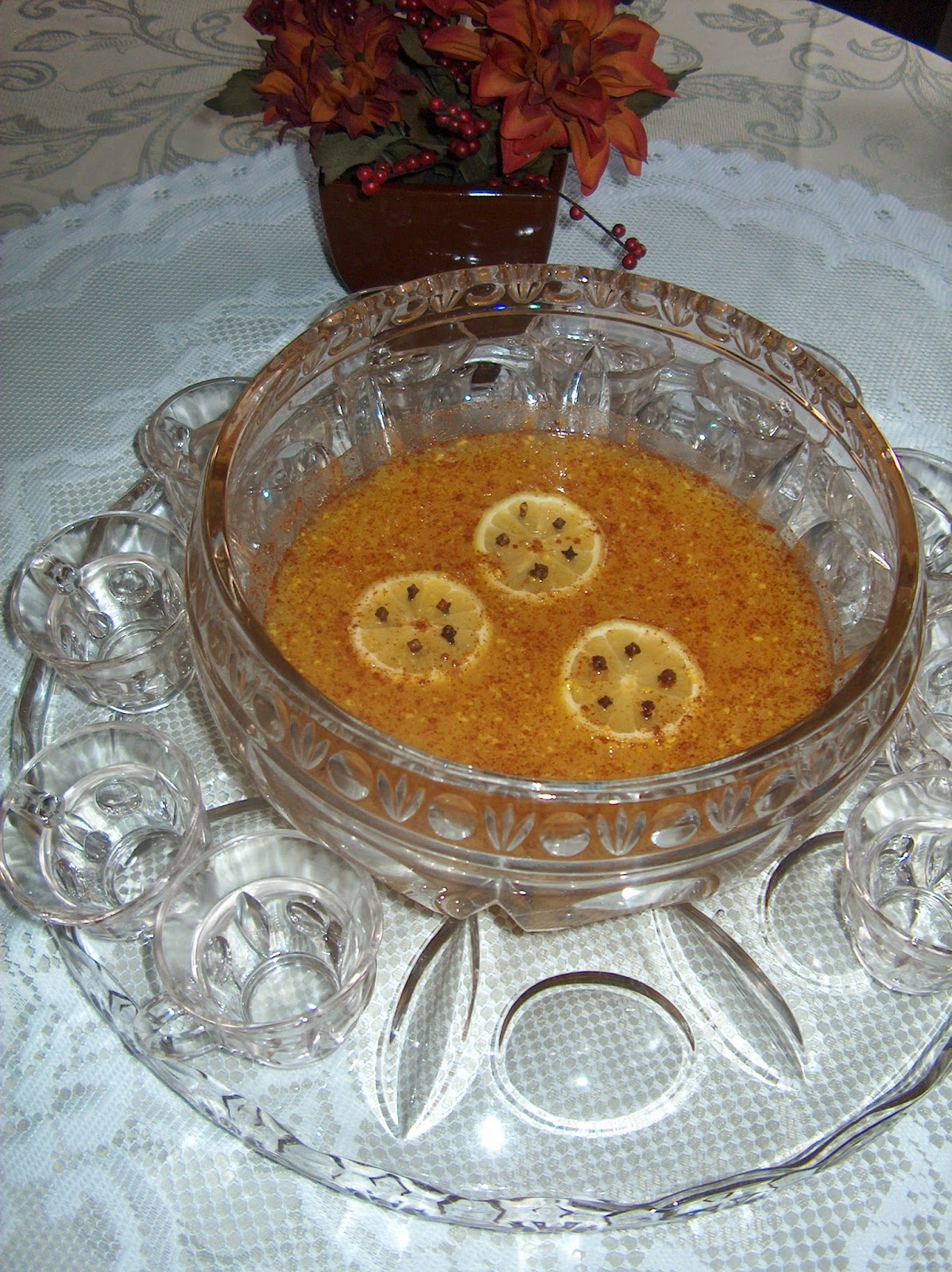
Our CBS Homemakers Exchange Recipes booklet for October, November, December 1950 has a tangy and sweet-sounding recipe for Spiced Orange Punch and we decide it would be the perfect beverage for our deck-sitting time.
 

First a trip to the store for some ingredients.  As I cruised the ice cream aisle I was amazed at the selection.  An entire aisle, shelf upon shelf, of frozen desserts!  After several tours up and down the aisle with willpower getting weaker and weaker, I finally spotted the sherbert on one top shelf.  Only four flavors?  Raspberry, orange, lime, and rainbow.  As I was standing there considering my options, a sweet and very tiny lady stepped in front me.  She could barely reach the top shelf for the raspberry sherbert and I prepared myself to catch her or the sherbert or both.  I asked her if that was a good flavor.  She beamed at me and told me that the raspberry and lime were the best and how she was going to make a drink using ginger ale.  I pointed to my ginger ale in my basket (or buggy as it is called here in the southern United States) and told her that I was making a punch.  We laughed and chatted about our recipes.  She told me how she used to have her punch at weddings all the time.  A very fun encounter!
 
With all ingredients in hand we prepare our punch.
 

Orange and pineapple juices, lemon rind, powdered sugar, cloves, nutmeg and cinnamon.

Added to the punch bowl with ginger ale.

Clove-studded lemon slices float on top.

A scoop of lime sherbert in the punch cup.

A froth of flavor!

This punch bowl with its ladle and 12 cups was given to me by Patrick's mother, Bernice.  It was her punch bowl before she married Patrick's father and was used at her bridal shower.
Bernice (second from right) at her bridal shower.  You can see a punch cup in the front of the photo.  Bernice and Arthur were married on June 23, 1946.  Perhaps this photo was taken in the spring 69 years ago.
 
Some day I'll pass this special set on to Patrick's daughters, but for today it was used for our special drink on the deck watching spring bloom in North Carolina.
 
Enjoy!
Patrick and Jeanette

Saturday, April 4, 2015

Historical Food Fortnightly Challenge #22 - Make Do or Do Without

22. Make It Do or Do Without March 22 - April 4
Working around food availability to gain a desired outcome has been a challenge throughout history. Whether supplementing seasonal produce, dealing with rationed or blockaded food in wartime, or re-imagining a dish without access to crucial ingredients, the cooks of the past had to get creative. Do homage to their ingenuity by interpreting historical substitutions.
 
The availability of food in is constant flux depending on the weather, season, transportation and labor costs, and demand.  Foods have even been genetically engineered for longer shelf life to enable shipping to feed those who might not otherwise have access to those foods.  Throughout our history we all know that war has drastically impacted food availability.  Another cultural impact is economic depressions and recessions whether on a global level or an individual level.  The wonderful thing about humans is that we seem to have a never-ending capacity for adaptation to all situations involving our food.  We make do on a level of creativity that sometimes becomes part of our culture.
 
The Great Depression of the 1930s was a severe worldwide economic depression.  Appearing in newspapers and cookbooks during that era is a dish known as "City Chicken".  It consisted of cubes of meat, usually pork, placed on a skewer and then fried and or/baked and often breaded.  Despite the name, the dish contains no chicken.  During the Depression pork was cheaper than chicken in parts of the United States especially those areas furthest away from the poultry farms of the country.  The dish is also known as "mock chicken" which was first described in the Winchester News of Winchester, Kentucky on 1 December 1908.  Depression era cooks often ground their meat and formed it into a chicken leg-shaped form and might have even used a mold to create the illusion.
 
Our CBS Homemakers Exchange Recipes booklet from April, May, June 1950 contains a Mock Chicken Legs recipe.  Obviously the make do recipe of times of hardship was tasty enough to stay in use.
 
Here is our recipe preparation today:
Our ingredients.

Cubed pork and veal.

Bread crumbs, beaten egg, thyme and spice mixture.

Skewer the meat alternating pork and veal cubes.

Dip in the egg mixture and roll in the bread crumbs.

Slowly fry on one side.

Turn when browned and slowly fry on another side.


Turn once more and slowly fry on another side.

Deglaze the fry pan to capture all those wonderful flavors.

Add the water and juices to the baking dish with the mock chicken legs.

Ready for the oven.

Baked just over 1 hour and the aroma is heavenly!
With the addition of a completely appropriate 1950s style lunch side dish of cheesy macaroni with bits of broccoli, we enjoy our mock chicken legs which are absolutely delicious!

 
As we enjoy our lunch we think about how appropriate this Historical Food Fortnightly Challenge is for today as Patrick readies for his duty as Honor Guard with the American Legion.  War has always greatly impacted our food supply causing people to make do or do without.  War has also impacted our society through the loss of life of those who fight to protect or gain freedoms.  Since 1919 the American Legion has performed thousands of burial ceremonies annually for the families of those who have served.  Patrick participates in these time-honored duties and this will be his second funeral this week to recognize the veteran and honor and thank both them and their family.


With thanks to all!
Patrick and Jeanette

Friday, March 20, 2015

Historical Food Fortnightly Challenge #21 - Rare/Scarce Ingredients

21. Rare/Scarce Ingredients March 8 - March 21
Just where does one find some of the ingredients for these recipes? That’s your job for this challenge! Find a recipe that relies upon an ingredient that can’t be had from the corner store, locate the ingredient, and recreate the dish.

If you love this -
 
 - or this -
Then you'll want to read this -
 
Leafing through our CBS Homemakers Exchange Recipes booklets from 1950 and 1951, we wondered how many rare/scarce ingredients there could possibly be in just 65 years.  Of course the increase in prepared/processed foods and fast food restaurants has changed our culture's eating habits tremendously.  Patrick remembers having his first pizza when he started college, and I first ate at a McDonald's fast food restaurant when I moved to Chicago at 40 years old.  Really!!  When I was a child we had two choices for a night out with children in our town in Wisconsin - the A&W, which my mom told me stood for 'amburgers and woot beer, and Dairy Queen for frozen desserts.  Now you can understand that growing up in the dairy state meant I had a very steady diet of milk, cheese, butter, and best of all - ice cream.  Root beer floats in frosty mugs, ice cream cones with little curls on top - what more could a child ask.  Heavenly!  Patrick's home state of North Carolina was also a top dairy state and as a teenager Patrick drove trucks for Biltmore Dairy.  Biltmore Dairy was operated by the Vanderbilt family at their estate in Asheville and has since been replaced by their winery operations.  As part of his benefit package Patrick was given milk, cheese, and - yes - ice cream!
 
So we were excited to find our April, May, June, 1950 booklet to have recipes for home-made ice cream.  Although I didn't intend to make those recipes for this Challenge, when I tried to find the ingredient Junket rennet in either powder or mix I was surprised that it or any substitute was not readily available in any of my local stores.
 
Rennet is a complex of enzymes produced and extracted from the stomach of certain animals.  It was primarily used in cheesemaking to separate the solid curd from the liquid whey.  The history of rennet use and the wonderful background of Junket Desserts since 1874 and the founder, Chr. Hansen, is best described on Junket's very fun and informative website.
 
 
If you have a child they might enjoy the illustrated story of Flibbity Jibbit and the Key Keeper and how they come to find the key to the King's rennet-custard cabinet.
 
 
Junket rennet products are ingredients in many of the recipes in the booklet we are using:


I had placed an order with Junket and received their chocolate, strawberry, and vanilla ice cream mixes and a package of rennet tablets to experiment with my own cheesemaking.
 
We first made the strawberry recipe:

Ingredients for Strawberry-Pineapple Parfait.
 
2 cups of light cream whipped for 2 minutes.

Ice cream mix added and whipped for a minute.

Placed in a freezer tray.

Frozen approximately 4 hours.

So creamy!!

Strawberries and pineapple on the left, strawberries only on the right.

Ice cream added and topped with a sliced strawberry.  Oh my!!!
Then the chocolate:
 

1 cup chilled evaporated milk whipped.
1/3 cup evaporated milk blended with water and then mixed with ice cream mix.

Whipped evaporated milk folded into ice cream mix combination.

Poured into a freezer tray.

Frozen for approximately 4 hours.

Marshmallows snipped into small pieces.

Frozen ice cream broken into chunks...

....and whipped until fluffy.

Marshmallows and nuts added and back into the freezer.

Ready to eat!

Oh my heavens and stars!  Topped with a mini Hershey bar!

We may never buy store bought ice cream again!  The recipes were so simple and the ice cream so glorious because of the fresh ingredients and the extraordinary flavors of the mixes.  Also gluten free for those who require that in their diet.  I would imagine every child and adult would have as much fun making these desserts as eating them.  We sure did!  The other great news is the cost.  A package of the ice cream mix is just $2.00.  The rennet tablets were $1.75 for a package of 8 and has recipes for ricotta, Neufchatel, feta, basic hard cheese and American mozzarella using whole or skimmed milk and buttermilk or yogurt for cultures.  There are also recipes for ice cream using milk and cream and your choice of flavorings - strawberry, peach, banana, maple walnut, chocolate chip, chocolate and coffee.  I see a whole new tangent of cheese and ice cream making in our kitchen!
 
February 29, 1992 - Our wedding day and intimate family celebration.  Everyone ate cake and ice cream including Bullette the kitty.
 

Enjoy!
Patrick and Jeanette
 
 
P. S.  If Junket products are not carried in your local store, we purchased online here: