Background

Saturday, September 20, 2014

Historical Food Fortnightly Challenge #8 - In a Jam

The Historical Food Fortnightly Challenge #8 is to make something to preserve our harvest or replenish our supply for winter.  The weather here in the piedmont of North Carolina has taken a decidedly autumn turn and leaves are already falling.  Temperatures are mild and it's perfect for spending time in the kitchen.

While our CBS Homemaker's Exchange Recipes booklets have several wonderful jam recipes, we were taken with an Apricot Ginger Conserve recipe in the April/May/June 1951 issue.

A conserve, by definition, is a whole fruit jam or a mixture of fruits and/or vegetables.  It may also include dried fruit or nuts. 

Our conserve recipe calls for Sunsweet apricots.  We've seen Sunsweet dried prunes in the grocery store and are wondering if dried apricots is what we're using for this recipe.  A little research leads us to a 1950 cookbook at auction with the following pages including the very recipe from our CBS Homemaker's Exchange Recipes booklet.


Copyright 1950


The same Apricot Ginger Conserve recipe we are using from our CBS Homemaker's Exchange Recipes booklet.


It's an interesting thought that a fruit could be dehydrated for storage and distribution, and then rehydrated and preserved at home in a new recipe.  We're excited to try it!
 
The shopping trip is a real eye opener!  Crystallized or candied ginger is usually available in the spice selections.  We retired almost a year ago from a position where we managed retirement communities which included full dining services so we hadn't cooked or shopped for over two years.  Of course it was sticker shock when we had to start shopping and cooking again, but no more shocking than in the spice aisle.  And today was no different when we saw that candied ginger was $9.00 for a 2 ounce bottle!  But fresh ginger root is reasonable and we decide to make our own candied ginger and buy a nice piece for 30 cents.
 
Here are all our ingredients and sadly Sunsweet offered only prunes.  We are only making half the recipe as we're just not sure if this mix of flavors will appeal to us.

To make candied ginger scrape the peel off the fresh root.  Slice it into 1/8" slim slices and boil in water for 30 to 40 minutes until the ginger is soft.  Drain, reserving 1/4 cup of the water.  Weigh your softened ginger and measure out an equal weight of sugar.

Combine sugar and ginger in a saucepan with the 1/4 cup reserved liquid.  Bring to a boil over med-high heat and boil over medium heat until the water begins to boil away.

Cover a baking sheet with parchment and oil a rack.  As the water boils off you will feel the sugar begin to reach the crystalline stage as it starts to stick to the pan.  At this stage remove your pan from the heat.
Spread your candied ginger pieces on your prepared rack and let them cool.  Once cool you can put them in an airtight container and use within two weeks.


But we are using them today for our Apricot Ginger Conserve.  The lemon and orange rind is grated and added to the water and sugar and orange and lemon juices.  The candied ginger is added.
 
The dried apricots are rinsed, drained, and added.  The mixture is brought to a boil and then the heat reduced to medium and boiled gently for 40 minutes stirring often.
 Meanwhile the glasses are sterilized.
 And the paraffin is melted in a double boiler.
After 40 minutes the chopped walnuts are added and boiled for 5 more minutes.
 The conserve is put into the glasses.
 And a thin layer of paraffin is poured over the hot mixture.
 Once everything is cool add another layer of paraffin swirling to coat completely up to the edges.


Yes, we kept some out for a taste test!  What a glorious flavor!  Some more internet searching and we found a NZ company that makes Apricot Ginger Conserve for $8.95 for 230g, about 8 ounces.  They describe it as being served warm or cold.  It can be spread on whole grain toast, scones, or on a cheese platter.  They say it is perfect on its own or as a glaze for fruit tarts and other desserts.  We can't wait to try all of that and will probably make the full batch next time.

Historical Food Fortnightly

The Challenge:  #8 In A Jam
The Recipe:  Apricot Ginger Conserve
The Date/Year and Region:  April/May/June 1951, United States
How Did You Make It:  Followed the recipe closely and made the candied ginger as well.
Time to Complete:  2 1/2 hours
Total Cost:  $10.30
How Successful Was It?  4 thumbs up at our house!  Having it tomorrow with waffles.
How Accurate Is It?  Completely.

Enjoy!
Patrick and Jeanette

Saturday, September 6, 2014

Historical Food Fortnightly Challenge #7 - The Best Thing Since Sliced Bread

When Patrick and I wrote that we were doing all recipes from 1950 and 1951 we were teased about the mid-century abundance of molded salads and aspics.  So now we just have to make one of those oh-so-memorable salads!  For your culinary pleasure and tastebud experience, we present......
 
Lime Gelatin Salad
 
What?!  No applause or expectant sighs?!  Not on this side of the computer either, but maybe part of the fun is in the molds, the jiggle, and the surprise of what's truly inside that transparent sugar-laden gel.
 
Gelatin has been around for centuries and has a multitude of uses.  It is a protein substance derived from collagen, a natural protein present in the tendons, ligaments, and tissues of mammals.  It is valuable as a basis in food processing jellied desserts, the preservation of fruit and meat, and to make powdered milk, merinque, taffy, marshmallow, and fondant.  It is also used to clarify beer and wine.  In industrial applications gelatin is used in making medicine capsules, photographic plate coatings, dying and tanning supplies, and paper production.
 
If you are interested in more detail you can read here:
 
A name we've come to know worldwide for the powdered flavored gelatin used in home cooking is Jell-O.   In 1897 Mr. Pearle Wait, a carpenter, while working on a cough remedy and laxative tea, experimented with gelatin and came up with a fruit flavored dessert.  His wife, May, named it Jell-O.  In 1899 Mr. Wait sold the formula for $450.  The sales and marketing success of the brand is an incredible story and told best by the Jell-O folks themselves.
 
So in the true spirit of the mid-century here is our Lime Gelatin Salad!
The Jell-O has to thicken slightly so while we've waiting I'll share a little of our personal history with you.  This is a four-generation picture of my family.   The baby is me, held by my great-grandfather Frank Hubbard Walker who was born August 24, 1865. My mother, Mary Ellen Case Sukanen born March 23, 1931. My grandmother Irma May Walker Case born March 17, 1897.  1897 - the same year Mr. Pearle Wait was developing Jell-O.
This photo was taken in 1950.  My father had epilepsy and although he and my mother had married, the state annulled the marriage since it was against the law for epileptics to marry, the thought being it was an inherited condition.  As a result I went to live with my grandmother and grandfather while my mother went to a nearby larger city to work.  Grandpa had been married and had 7 children when his first wife passed.  He married my grandma and they had 6 children of their own.  My mother was near the youngest of the second group and my blessed grandma had raised all 13 children and now was taking care of me.  Most amazing was that she was doing this in a home in northern Wisconsin without running water or indoor plumbing.  Everything was cooked and heated on the big wood stove in the kitchen, the well pump handle was part of the kitchen sink, and there was an outhouse a brisk walk from the house during the winter and chamber pots under the beds.  It was a wonderful life!  Well, to me it was!
 
Back to the Lime Gelatin Salad - the Jell-O is partially thickened, all the veggies are diced, and the molds are prepared with a thin coating of oil.  Since I don't have any true salad molds I'm using my dessert glasses, a leaf-shaped muffin pan, and a gingerbread village pan.  Should be interesting shapes even if the flavor is not.

While the molds are in the refrigerator for the final firming, I want to share with you something that was an absolute shock to me.  Thinking back to 1950 to 1953 at which time my mother remarried, I lived with Grandma and Grandpa in the house without the plumbing.  We heated all our water on the wood stove, washed clothes in wash basins with a scrub board and hung them on the clotheslines to dry, we heated the water and took baths in the big tub.  For all these years I never thought about what might have been invented and available to the general public until I saw this page in the same recipe book I'm using in this Challenge.
 
Range, refrigerator, dishwasher, automatic washer and dryer.  I was stunned!  "Hotpoint for better living - in '51 and the years to come."  Did Grandma even know such things existed?  Even as a pre-teen visiting her in that same house she was always so cheerful and seemed so satisfied and not wanting for anything.  I still remember that fabulous Easter dinner made in the big wood stove.  So The Best Thing Since Sliced Bread for me is our wonderful appliances!
 
Time to unmold our salads and taste test!  The first is in the dessert cups.  A short dip in hot water, a knife around the edge and unmolding is easy.
The dessert cup didn't give much of a shape but Patrick tasted it anyway.  He said "I hope you like it".  Which means he doesn't.  I'll admit, the mouthfeel is odd.  The veggies are very crunchy but the gelatin is smooth and it took a few forkfuls for me to get used to it.  But it is very fresh and refreshing.  I added the mayo and pimiento to the top of a molded salad and the presentation is pretty.  Blurry in this photo, but pretty.
 
Next I tried the leaf muffin pan molds.  Again a short dip and they came out easily onto a flat plate.  I took a spatula and moved them to the smaller, lettuce-lined plates.  With some dressing I think this would be a nice serving.  The mold created some great detail into the salad.

Lastly, the gingerbread house mold.  A dip in warm water and it, too, slid out easily.  It would have been great fun to fill the entire gingerbread village and lay out fresh fruit and veggies throughout and serve.


Historical Food Fortnightly
The Challenge:  #7 The Best Thing Since Sliced Bread
The Recipe:  CBS Homemakers Exchange Recipes April, May, June 1951
The Date/Year and Region:  1951, United States
How Did You Make It:  Followed recipe exactly with a variety of molds
Time to Complete:  6 hours
Total Cost:  $4.00
How Successful Was It?  Only 2 thumbs up - mine.  Patrick says he only likes Jell-O pudding.  Chocolate preferably.
How Accurate Is It?  Not having any vintage molds, not very on that end.  But the recipe is accurate and, you know, There's Always Room For Jell-O.
 

Anyone up for chocolate pudding?
Patrick and Jeanette

Saturday, August 23, 2014

Historical Food Fortnightly Challenge #6 - Seasonal Fruits and Vegetables

The end of August in the piedmont of North Carolina is hot, humid, and hot.  The vegetable gardens may still have a burst of tomatoes but with sudden thundershowers they are also likely to burst before they ripen.  In the mountains the blueberries are thriving, and the apples are not yet ready, but there is one item you can find an abundance of at the local farmer's markets - sweet potatoes.

Highly nutritious and versatile, the sweet potato has been cultivated for over 5,000 years possibly originating in central and south America.  It is a tuberous root vegetable only distantly related to other potatoes.  It is also distinct from a yam and even related to the morning glory and its skin and flesh come in a multitude of colors.

The CBS Homemakers Exchange Recipes has 2 wonderful-sounding recipes and 1 recipe that sounds so strange we have to try it.  Here is the pictorial story of The Sweet Potato Parade.

1.  Baked Stuffed Sweet Potatoes
The Recipe Book:  Jan/Feb/Mar 1951

The Recipe

The Ingredients

Baked, Scooped, and Ready for Filling

Filled and Ready for Second Bake

Baked Again

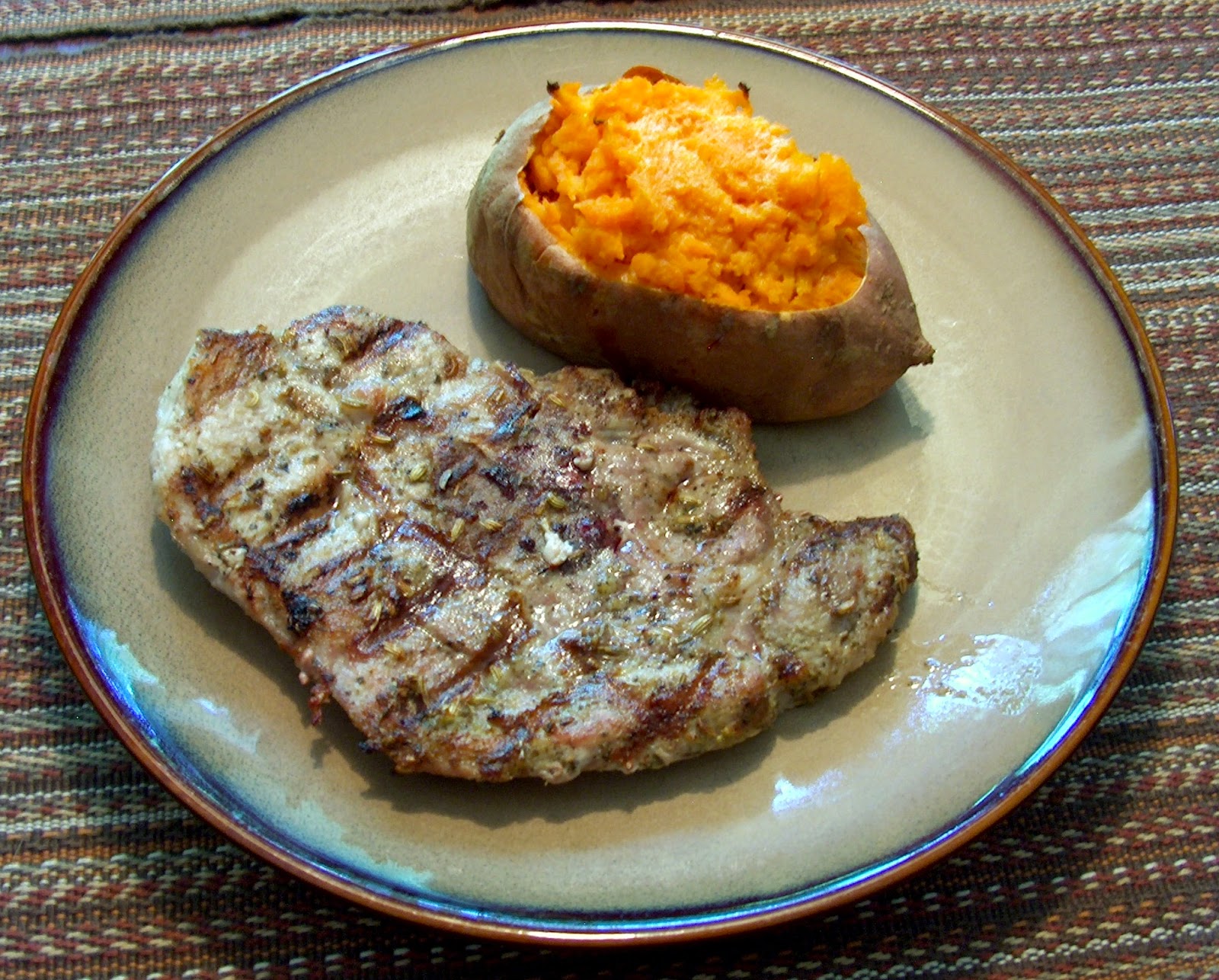
Served With Fennel and Rosemary Marinated and Grilled Pork Chop
2.  Oven Browned Sweet Potatoes
The Recipe Book Jul/Aug/Sep 1951
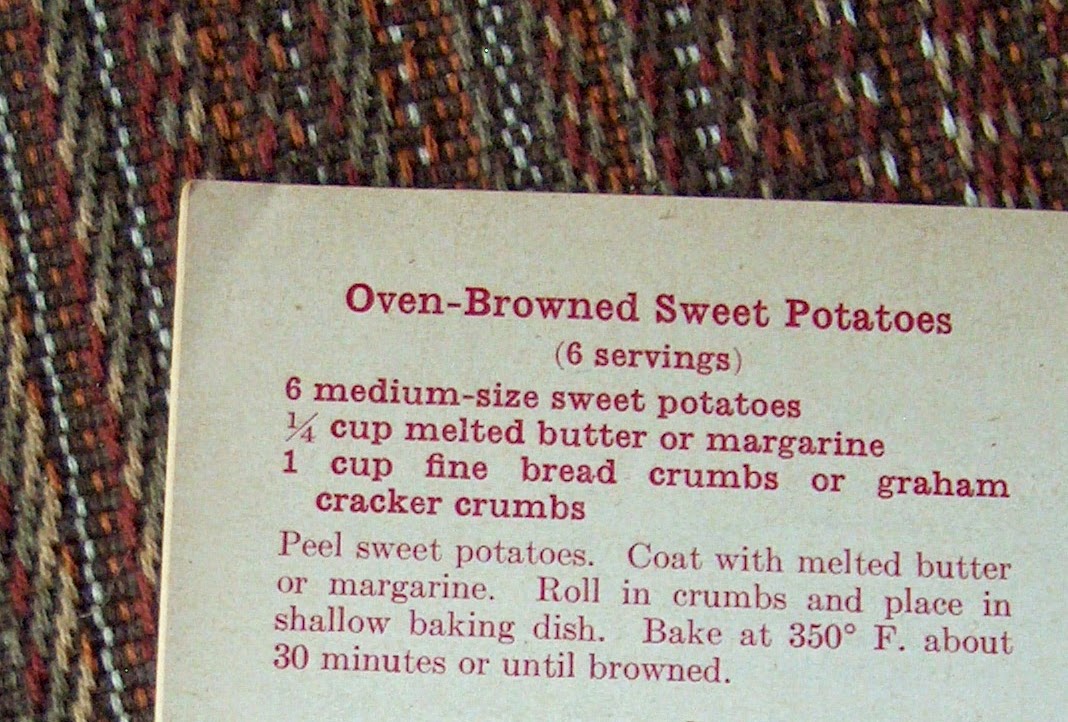
The Recipe
The Ingredients

Peeled Sweet Potatoes, Graham Cracker Crumbs, Melted Butter

Ready for Baking

Baked and What a Wonderful Aroma!

And now for the recipe that we had to make but agreed we would try but might not eat.  Haha!
3.  Escalloped Sweet Potatoes and Prunes
The Recipe Book Jan/Feb/Mar 1950
The Recipe
The Ingredients

Ready for Baking


When does a prune taste like a sweet candy?  When it's baked in this recipe!
The results of The Sweet Potato Parade Taste Testing is................4 thumbs up for all 3!

Patrick's mom, Bernice, would be so proud of us.  This is Bernice is 1946 when she married Patrick's dad, Arthur.

She was an independent woman, born and raised in North Carolina, and knew more about food preparation than anyone I had ever met.
But then Patrick should tell you the story...................


      "From the mid 1960's into the late 1990's, Bernice Murray, my Mom, was a well known Southern-style caterer in South Central North Carolina.  While most of her catering events were in and around Anson County, it was not unusual to find her turning fried chicken and stirring cream style corn in banquet halls from Charlotte to Raleigh.
 
Now being a growing high school boy of sound mind and appetite, I knew where to find a good meal when there was catering going on.  My Mom and Dad had the Friday/Saturday night dinner concession at our local Country Club and Bernice's staff was always preparing things for the upcoming catering events that weekend.  Knowing better than to ask Bernice for a mere taste of whatever was on the stove, I would go directly to Laura-Ann, her head cook, and with a little sweet talking I usually walked out of the there with a plate full of supper. 
 
But not this Friday night!  Bernice intercepted me at the back door of the Country Club and told me that she was cooking for 500, not 501, and there was a pound of hamburger in the refrigerator at home. Fix yourself a burger and fries. Leave!  So hungry and mad I drove back to our house, got out the hamburger, poured oil in the pot for french fries, turned on the burner, and for some unknown reason, decided I had time to do one math problem in my room while the oil heated up.  Being math challenged, that problem took more time than I had figured on and I was suddenly interrupted from my calculations by a loud WHUMPH that came from the kitchen.  I found the pot of french fry oil looking more like the tail end of a rocket with the flames reaching the underside of the wooden cabinet above the stove and curling around and up to the white ceiling.  The stove top was completely engulfed in flames and dark, oily smoke filled the kitchen.  Being a quick thinker and action oriented I ripped off my T-shirt and threw it over the flaming pot which smothered the flames for approximately .01 seconds but long enough for me to grab a gallon pitcher of sweet tea from the counter and doused the pot and the stove top in one desperate attempt at firefighting.  Blazing oil and water...right...BUT IT WORKED!!!   Hot, smoking oil was splashed everywhere in that kitchen. The stove was history. The cabinet was heavily charred and there was a black hole in the ceiling tiles above the stove.  The smoke damaged five other rooms in the house.  But worst of all...I had to call Bernice.
 
Being of sound mind and a big chicken, I called my Dad instead.  Told him I had burned up the stove and some of the kitchen, don't tell Mama but come home...NOW!  He made the five minute drive in under two.  I am sure he asked me if I was all right in there somewhere but all I could think about was Bernice, who by now had figured something was up and was on her way home. With no chance to break the news to her in a controlled way, she walked right into a smoke filled, burned out kitchen and gave me the surprise of my life.  She grabbed my shirtless self and gave me the biggest hug ever.  She then looked me over to see if I was all right and found several small blisters coming up on my face and chest which I had not even felt.  She told me she was thankful that I was all right and that insurance would cover most of the damage she was sure but now she had to figure out how to cook for all those people at the events that weekend.  And so it goes.
 
News spreads fast in a small little town and people were calling before the smoke cleared.  How can I help?  By noon the next day, Bernice had friends and neighbors cooking stuff all over the county.  I'm sure everyone at the events got fed because I put several hundred miles on the company station wagon picking up string beans in Ansonville or apple pies in Morven.   One thing for sure though...french fries have never tasted the same."
 
So whether sweet twice baked, with graham crackers or prunes,  
or even French fries, think of us when you next enjoy a potato!
Patrick and Jeanette
 
Historical Food Fortnightly
What It Is:  The Sweet Potato Parade
The Challenge:  #6 Seasonal Fruits and Vegetables
The Recipe:   Baked Stuffed, Oven Browned, Escalloped with Prunes
The Date/Year and Region:  1950 and 1951, United States
How Did You Make It?  Followed recipes closely
Time to Complete?  2 hours 30 minutes
Total Cost:  $.99 per pound for sweet potatoes, $2.39 for package of prunes, $.67 for an orange
How Successful Was It?  4 thumbs up!
How Accurate Is It?  Rated by a North Carolina native (Patrick) it is completely spot on.